Thursday, February 23, 2012

Ads Specific to You


Advertisements catered to you and your interests have not been around for a very long time. What is this trend? Lets look at this new trend and how it is affecting the world of advertising.

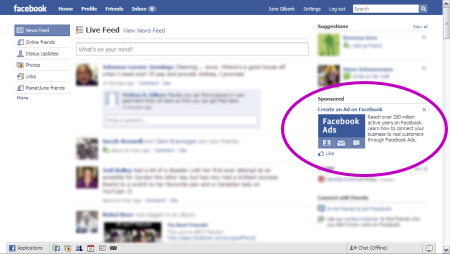
Have you noticed that alongside your Facebook page or news feed there are several ads? The ads that are placed there are not the same for everyone. Have you noticed that the ads you see there are usually for something that interests you or for something that can be found around your geographical location in the world?

This is a screen shot of my Facebook account with ads specific to my interests and recent activity while online.

The ability to specialize the ads, which people are seeing, is due to the new concept of behavioral targeting. Lauren Drell, associate editor of supported content of Mashable explains how behavioral targeting works:

Targeting companies establish an agreement with a publisher, who puts a piece of code on his website. (That publisher must have a clearly stated policy for the consumer to opt out from having data collected.) Then, when you’re browsing the web, the site will put a cookie on your browser, which populates as you surf.

Now that your browser has a cookie, the targeting begins. Data points amass as you click your way from site to site, taking note of what you buy, what you read and what you search for. The more time goes on, the more data is collected.

The advertising companies use that information to personalize the ads that will show up during your time online. This seems like a neat feature for both the advertising company and for us as the consumer. The ads we will be seeing will be for products that we actually enjoy or would like to have.

At first thought it seems to be a win, win situation. But do I really want my activity online to be recorded? It works for specializing my ads but is that all that that information is used for?

This act of behavioral targeting is now spreading to your mobile devices. There is still much room for improvement when it comes to the mobile devices but it is predicted that mobile ad market will generate $20.6 billion by 2015 and paired with behavioral targeting the number will only keep increasing.
http://www.samsung.com/us/topic/our-smart-tvs

This concept is now also being introduced to TV. To the left is the TV that Samsung recently came out with that is able to connect to the Internet. 

 I do not believe it is not too far into our near future when we will only see ads that are chosen for us based off the shows we watch and what we browse on the Internet through our TV.

Wednesday, February 22, 2012

$3.5 Million enough for ya?


What is the first thing that comes to mind when you hear the word Super Bowl? My guess is, a big football game with a very close second, commercials. It is not uncommon for people to watch the Super Bowl purely to watch the commercials and not the game. I am one of those people who could really care less about the game but if I were to watch it I find more enjoyment in watching the commercials verses the game itself.

The commercials during the Super Bowl are not cheap. Volkswagen paid $3.5 Million dollars for their 30-second spot during the championship game. That is sure one pretty penny, if you ask me.

As a senior at North Dakota State University who is finishing up my minor in public relations and advertisement along with my degree in Architecture I find it very interesting how companies use their very expensive 30 seconds. 

It never fails, after every Super Bowl there are two lists. The good and the bad. Just think spending $3.5 million dollars and the commercial ends up being a dud. However, is it really a dud when so many people are taking about it, good or bad? In the world of advertisement talk is talk and even if it is negative it is still causing attention to the ad and then in return the product the commercial is promoting.
http://www.theatlantic.com/business/archive/2012/01/
why-super-bowl-ads-keep-getting-more-expensive/250810/

Super Bowl 46 was also known not just for it’s commercials, like every other Super Bowl, but also for being the most “social” Super Bowl ever, and broke new ground in several areas of integrated digital marketing. This year the Indianapolis Super Bowl Host Committee and the local social media agency Raidious joined forces to create the first ever, social media command center right in Indianapolis for covering the game.

Fans everywhere were able to watch the game on television while also logging into their Facebook, Twitter, Google+ accounts and get updates or have any questions answered that they might have about the game. Those sites have their own advertisement, which are automatically built in. So with those advertisements, plus the very expensive advertisements aired during the game, people were surrounded by more advertisements than they probably even knew what to do with.

Why you ask is commercial air space so darn expensive? Why the heck would a company want to pay that much money for airing and advertisement?


According to Jordan Weissmann, associate editor of   The Atlantic, “audiences have fractured the age of      Hulu and DVR, the Super Bowl is among the last of an     increasingly endangered species: The truly mass audience live TV event. In good times and bad, that distinction has been worth a premium to advertisers.” The amount of people that watch the game is huge and increases every year. And Nielson found that, Super Bowl ads are 58% more memorable than regular TV ads.


Are all those circumstances are enough for 3.5 million dollars for 30 seconds right?


Friday, January 27, 2012

Fast Forward Affects...Or does it?

images
Technology is helping yet hindering the world of advertisement. Digital Video Recorders are great for people who are watching TV but not great for advertisement companies. I am going to look into the pro's and con's of DVRs in respect to the advertising market and also look at what the future potentially holds (or does not hold) for this type of technology.

DVRs allow people to record a show that they want to watch, and watch it at a time convenient to their schedule. This also allows people to fast-forward through commercial breaks. Even though my interest is in advertisement and I plan on working in the advertisement industry when I am done with school, I have to admit I really do enjoy fast forwarding through the commercials. The consequence is that companies are spending a lot of money for their 30 second time slot and now a lot of people are able to fast forward right past it. Erik Du Plessis the chairman of Millward Brown South Africa, a visiting professor at the Copenhagen Business School and the author of The Advertised Mind (Kogan Page, 2008) wrote in the article Digital Video Recorders and Inadvertent Advertising Exposure, "It has been argued that the 30-second TV advertisement is dead because owners of digital video recorders fast-forward through advertisements." However he also states later on in his article that, "it is not easy to fast-forward through a commercial. In fact, advertising avoidance requires paying close attention to the television screen-- an act that may result in inadvertently paying more attention to the message." The chart below compares the ability for a viewer to recall  a commercial when paying attention to it while being fast forwarded verses in real time. According to the chart watching a commercial being fast forwarded does not have as big of an effect that I would have guessed. 

F1004C_A_lg.gif
There are times when I find commercials to be beneficial. I often use commercials as my excuse to watch a show that I want with the plan of muting the TV during the commercials and working on my assignment.

I was not surprised to see that thoughts are already underway in figuring out how to make changes so people are unable to by pass all the advertisements. In an 2010 article from the Los Angeles Times, the networks are aware of the trend of people skipping the advertisements and "ultimately are looking to video-on-demand to replace the DVR. In other words, picture a day when instead of recording that episode of "Two and a Half Men" on your DVR, you order it on video-on-demand. The only difference would be that on VOD the ads would be there and you wouldn't be able to skip them."

I am not worried about the advertisement industry coming up with a new way to get around the ability to bypass advertisements. Next thing we know the technology that we are use to and using today will have changed greatly.

Thursday, January 19, 2012

Facebook Advertisement

facebook_ads.png
Advertisement can be found everywhere. It seems as if no matter where you go you are never able to escape ads. This is especially true with the largest social network out there, Facebook. Facebook uses many different ways to expose their members to advertisements. Harry Gold, founder and CEO of Overdrive, wrote the article, Seven Ways to Advertise on Facebook, which explains the seven ways he found advertisement happening on Facebook. According to Gold, “If you want to immerse yourself on Facebook, the first and most important step is to set up a Facebook page.” He also mentioned to, “(take note that this is different from a Facebook profile, which represents an individual).” The next five things Facebook offers are Sponsored Stories, Sponsored Social Stories, Video Sponsored Stories, Box Ad Units, and Display Units which all fall under the umbrella of Facebook Ads. The last way of advertising according to Gold is through gift sponsorships. Gold also states that due to the fact of the ever-changing Internet he, “may be inadvertently omitting some because new features are being added. That is quite a bit of ways to advertise on only one website. 


I notice that there are a lot of ads on every page of Facebook. After a while I find that I do not notice the advertisements anymore which I think happens to most people. However the people at Facebook are aware of that and are always trying to come up with new and creative ways to get peoples’ attention when it comes to advertising. The two new features that are up and coming within Facebook are Engagement Ads and advertisements showing up in peoples’ news feed. Jeremiah Owyang, an Industry Analyst on Customer Strategy and Partner at Altimeter Group explains engagement advertisement in his blog posting What Facebook’s New ‘Engagement Advertising’ Means to Brands as, “Rather than clicking on the ad and being whisked away to a branded microsite, these ads allow members to stay within the contained walls of Facebook and their social community." It is a great way for people to get more information about a product that catches their eye while on Facebook while not having to leave the Facebook site. The video  above explains this new type of advertisement very well http://www.youtube.com/watch?v=-wHsfeWkXvMIf you did not think there were enough advertisements on Facebook, you are in luck. According to Shelly Palmer, the host of NBC Universal's Live Digital with Shelly Palmer, “Starting in January of 2012, sponsored stories will appear in your news feed on Facebook.  Advertisements will find their way in between your friend’s updates and there’s nothing you can do about it.” The act of blocking out the advertisements on Facebook is going to be a lot harder when the advertisements are intertwined with all your friends’ postings in your news feed. Facebook is doing a good job keeping up with how people are viewing advertisements and then adjusting the site accordingly.